
The Lost Art of Creation_ Reclaiming Depth in a World Addicted to Quick Highs And Dopamine

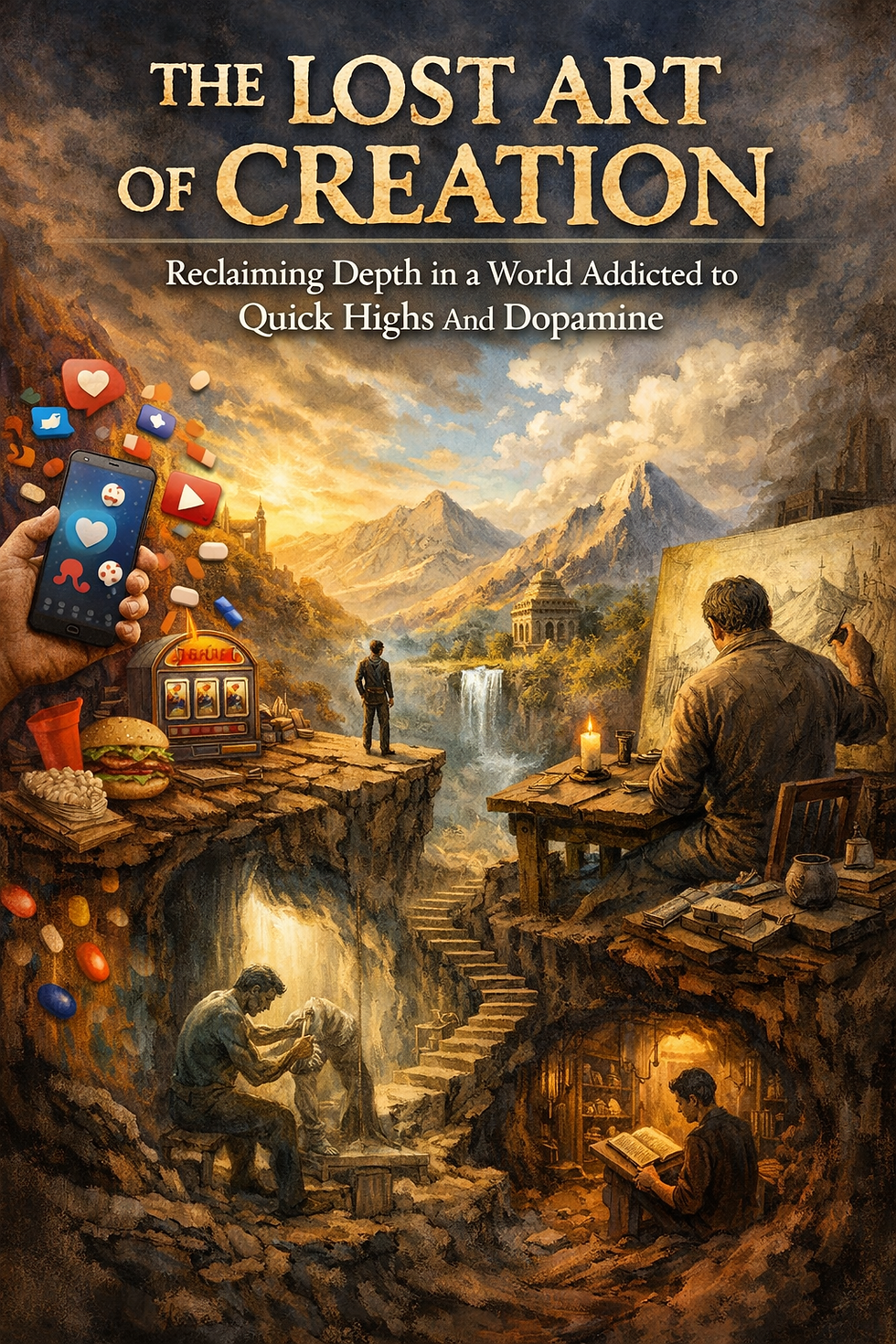
In today’s world, most of us don’t realize we’re chasing a drug.
We scroll for it. Shop for it. Post for it. Swipe for it. A hit of dopamine here, a spike of serotonin there. Short-form videos, breaking news, 24/7 availability of entertainment, matches, messages, and memes , all available in seconds, all engineered to keep us hooked.
But this isn’t a morality tale about phones or screens. This is about what happens to the psyche , and the soul , when your reward circuitry is hijacked for so long that you forget how to sit still, make something from nothing, or feel awe without needing it to be validated.
Because the opposite of dopamine-driven consumption is not abstinence. It’s creation.
What Quick Dopamine Does to the Brain
Neuroscientifically speaking, dopamine is not the “pleasure chemical” people think it is. It’s more accurately described as the anticipation chemical, the neurotransmitter that makes you crave something before you get it. It’s why you feel that itch to check your phone, not just the satisfaction of doing so.
Apps, ads, and algorithms have learned to exploit this. They offer variable rewards (a psychological trick studied in operant conditioning) , meaning, not every scroll gives you a reward, but some do, and that unpredictability is what makes it addictive.
Over time, this skews the brain’s reward system. Natural sources of fulfillment, deep connection, long-term projects, effortful learning, or unmonetized hobbies, feel dull in comparison. And that’s not a metaphor. Your nervous system is literally learning to associate effortless input with reward and effortful output with... nothing.
Which is why creating anything, a story, a drawing, a recipe, a melody, even a moment of mindful silence, feels so foreign and hard at first.
Creation as a Neurobiological Rebellion
But here’s the trick no one tells you: when you create, you still get dopamine. You just get it differently.
Studies on flow states (coined by Mihaly Csikszentmihalyi) show that when people are deeply immersed in meaningful, self-directed tasks, they experience reduced activity in the prefrontal cortex, the part of the brain responsible for self-criticism, time awareness, and performance anxiety. The result? Time slows down, you feel present, and the reward becomes the process itself.
This is the anti-dopamine chase. Not because you’re cutting yourself off from joy, but because you're rewiring your system to remember that joy can come from within. From trying. From failing. From finishing.
In fact, the longer it takes to complete something, and the more effortful it is, the more satisfaction you’ll feel upon completion. That’s not just a cliché. That’s the difference between quick hits and sustainable gratification.
Creativity Isn’t Just About Art, It’s About Aliveness
Let’s be clear: creativity doesn’t mean painting murals or writing novels (unless that’s your thing). Creativity is about engagement, with life, with others, with yourself.
It can look like:
Solving a problem at work in a new way
Cooking something you’ve never tried before
Writing a letter to someone you love
Organizing your space to feel more like you
Journaling your dreams, not for productivity but for exploration
Building a small garden, playlist, or memory
These acts might not bring followers or applause. But they’ll bring you back to yourself. To your values. To your inner world. And that reconnection is the very thing most of us are starved for, not content.
Why We Avoid Creation: The Fear Beneath the Surface
If this all sounds obvious, ask yourself: why don’t more of us do it?
The truth is, creating is vulnerable. It forces us to confront our limits. To be beginners again. To make things that might not be liked or validated. And for a generation raised on curated perfection and instant feedback, that’s terrifying.
So we avoid it. We scroll. We watch others create instead. And we wonder why our anxiety keeps rising even though we’re “resting.”
But rest isn’t always passive. Rest, sometimes, is active , it’s choosing to reconnect with the parts of yourself that aren’t constantly seeking performance.
The Nervous System Needs Slowness, Not Stimulation
From a trauma-informed perspective, our nervous systems are already overstimulated. The modern world asks us to process more inputs in a week than our ancestors did in a year.
For the anxious, the chronically online, the perfectionists, and the heartbroken , the medicine is often not to consume more answers. It’s to slow down enough to hear your own.
Creativity invites regulation. Breath. Focus. Non-linear joy. That’s the irony , it’s not a luxury, it’s a nervous system tool. One that can heal you from what quick dopamine has hollowed out.
The Invitation
So this is your reminder:
The world does not need another person chasing stimulation just to feel okay. The world needs someone who can remember how to feel without being fed. Someone who makes something with their hands. Writes something only they’ll ever read. Moves their body not to perfect it, but to feel it. Sits with their boredom long enough for it to become curiosity again.
Not because it’s trendy. But because it’s freeing.
And because you were not built to be a consumer alone. You were built to create.
At Reframing You, we believe healing happens not just through insight, but through identity reformation. You don’t need to stay in the triangle to be safe, needed, or strong. You can rewrite the script.
Reframe You. Reframe Society.


Comments